

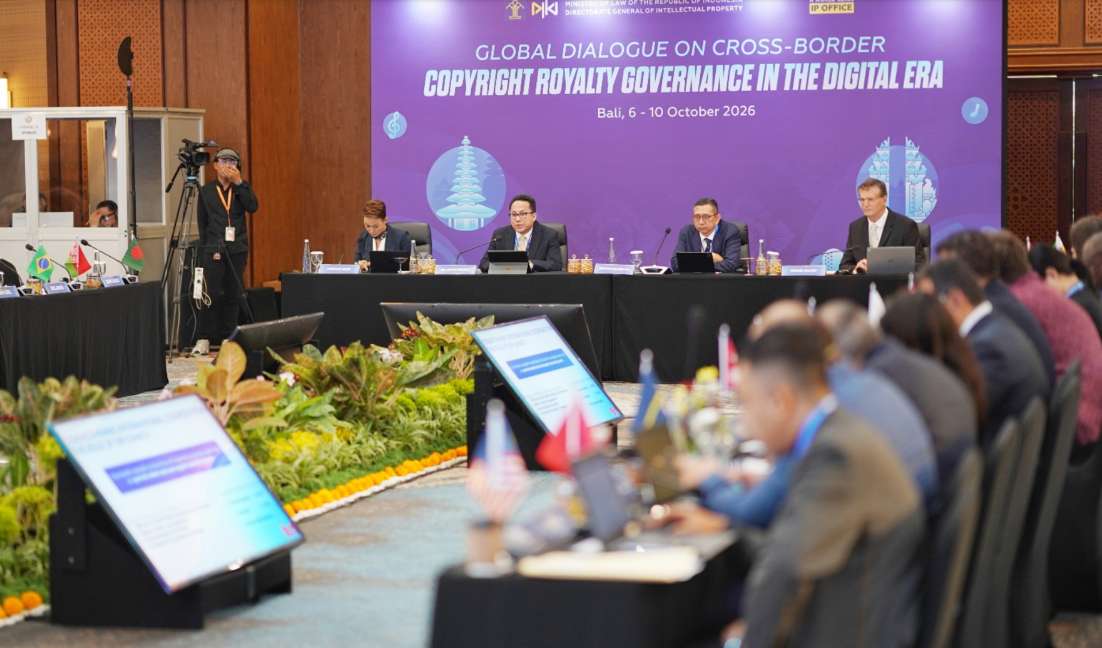
MATRAS ENGLISH, BALI – The Government of Indonesia has brought together delegates from 35 countries, international organizations, collective management organizations, creators, industry representatives and experts to discuss cross-border copyright royalty governance in the digital era.
The Global Dialogue on Cross-Border Copyright Royalty Governance in the Digital Era, held in Bali from 7–9 October 2026, focuses on three key issues: transparency, accountability and system interoperability.
“Through this Global Dialogue on Cross-Border Copyright Royalty Governance in the Digital Era, we are seeking to promote common rules and systems so that copyright royalties, which are increasingly flowing across national borders, can be recorded, calculated and distributed in a more transparent, accountable and fair manner,” said Indonesian Minister of Law Supratman Andi Agtas.
The Government of Indonesia initiated the dialogue through the Directorate General of Intellectual Property (DGIP), and it runs from 7 to 9 October 2026. A total of 35 countries are participating in person and online, bringing together member states of the World Intellectual Property Organization (WIPO), two intergovernmental organizations, six collective management and industry organizations, and experts, creators, and other stakeholders.
“As creative works can now be enjoyed across countries through digital platforms, royalty governance must also keep pace with these developments. Transparency, accountability and interconnected systems are essential to ensure that creators’ economic rights are protected,” Supratman said.
According to Supratman, cross-border royalty issues are not solely a matter of copyright regulation, but also involve coordination among institutions and the connectivity of information systems. Indonesia is therefore encouraging international dialogue to exchange experiences and practices among countries while respecting their respective national legal frameworks.
“This forum provides a platform to build a shared understanding and explore practical cooperation. The objective is to ensure that creators and rights holders receive fairer economic benefits from the use of their works in the digital environment,” he said.
Director General of Intellectual Property at the Ministry of Law, Hermansyah Siregar, said that challenges surrounding cross-border royalties are often more closely related to information exchange than to copyright law itself. Incomplete ownership data and metadata, as well as differences between systems, can make it difficult to match the use of creative works with the appropriate rights holders.
“Friction in cross-border royalties is rarely a dispute over copyright law. The main challenge is information exchange,” Hermansyah said.
He explained that these challenges can arise throughout the process, from registering works and reporting usage to metadata matching that connects usage reports with rights holders. When identifiers for creative works are unavailable or incomplete, royalty calculation, distribution and reconciliation become increasingly complex.
Data from the International Confederation of Societies of Authors and Composers (CISAC) show that royalty collections by creators’ rights management organizations worldwide reached €13.97 billion, or approximately Rp278 trillion, in 2024. Of this amount, €5.14 billion, or around Rp103.16 trillion, representing approximately 37 percent, came from digital uses. However, royalty collections remain concentrated in Europe and North America.
The dialogue addresses three main areas: transparency, accountability, and interoperability. Transparency concerns the information made available to rights holders, while accountability relates to responsibility at each stage of royalty management. Interoperability refers to the ability of different systems to exchange information reliably.
At the international level, WIPO has also promoted good governance in collective management through publications and technical assistance, including good-practice guidance for collective management organizations and the TAG of Excellence initiative, which focuses on transparency, accountability and governance. These efforts are expected to be further developed with stakeholders through professional rules and governance standards for member organizations.
In Indonesia, Law No. 28 of 2014 on Copyright governs copyright and provides the national framework for collective management. In addition, Government Regulation No. 56 of 2021 on the Management of Copyright Royalties for Songs and/or Music establishes the framework for collecting and distributing royalties.
The regulation also provides for a national song and music database managed by the Directorate General of Intellectual Property, as well as the Song and/or Music Information System (SILM), which supports recording works, usage data, and royalty distribution.
Hermansyah said system connectivity is critical to ensuring that royalties can flow effectively from the use of a work to the relevant rights holder. Indonesia is also developing the Song and Music Data Center (PDLM) and related information systems to strengthen connectivity with global royalty systems.
“Interoperability simply requires systems that can communicate reliably. Today, many emerging markets still lack the IT infrastructure needed to process large volumes of digital data,” he said.
Indonesia has previously presented its proposal on royalty governance, known as the Indonesian Proposal, to WIPO’s Standing Committee on Copyright and Related Rights (SCCR). Discussions on the proposal will continue at the SCCR, while the Global Dialogue in Bali provides a platform for countries and stakeholders to exchange experiences and identify practical solutions that could be developed voluntarily.
“Technology has democratized the distribution of musical works. Our task now is to ensure that our governance structures also democratise remuneration for those works,” Hermansyah concluded.