


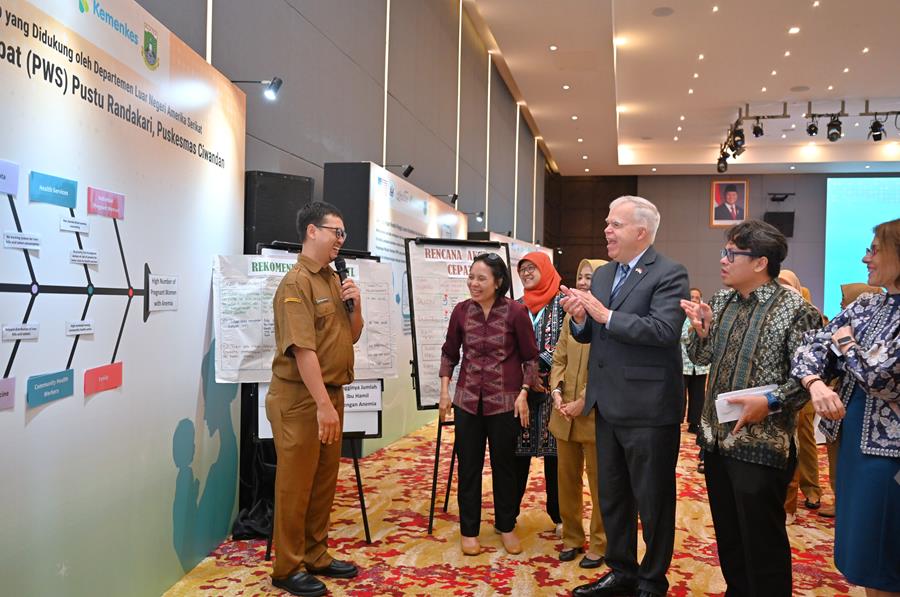
MATRAS ENGLISH, SERANG – The U.S. Embassy in Jakarta, in partnership with the Ministry of Health and Banten Province health authorities, hosted a Learning and Transition Event on May 12 in Serang, Banten, to celebrate significant achievements in improving the health of mothers and newborns and mark the transition of U.S. government-supported health programs to local government leadership.
The event highlighted the success of the MOMENTUM Country and Global Leadership (MCGL) project, which has improved health systems for mothers and newborns across Indonesia since 2021. In Banten Province, the project operated in five districts and cities, introducing a Collaborative Quality Improvement approach that improved clinical skills of frontline healthcare providers and expanded the leadership of community health workers in delivering essential health services to mothers and newborns.
“The United States is proud to partner with Indonesia to improve its services supporting the health of mothers and newborns in Banten Province,” said U.S. Chargé d’Affaires a.i. Peter M. Haymond in his opening remarks. “It worked. Maternal mortality decreased 55 percent at U.S. government-supported MOMENTUM facilities. This success demonstrates what can be achieved through evidence-based approaches and strong local ownership. U.S. health assistance is designed to foster self-reliance in recipient countries. We are achieving that goal together by transitioning these critical life-saving interventions over to local leadership in Banten, while also continuing to save lives for years to come.”
Key achievements in Banten Province include a 55 percent reduction in institutional maternal mortality from 214.4 to 95.7 per 100,000 deliveries across 26 supported facilities between 2024 and 2025, a decrease in institutional neonatal mortality from 16.2 to 15.5 per 1,000 live births, and over 300 trained community health workers who conducted more than 6,000 home visits, reaching over 16,000 individuals.
Banten Province has demonstrated strong progress in scaling up these interventions, with 134 health facilities now participating in the quality improvement collaborative across districts. Building on the foundation of 46 U.S. government-supported sites, district health offices have independently expanded the program to 88 additional facilities using Indonesian government systems and resources, nearly tripling the program’s reach. Banten is now well positioned to sustain and further expand these interventions under full local government leadership.










Komentar ditutup.